For decades, railroads have accepted a hard truth about frogs and crossing diamonds: manual welding keeps them running, but only for so long. Patch repairs slow the wear, post-grind work eats up track time, and eventually every frog gets pulled and replaced. Laser hot wire cladding is challenging that assumption, and the field data is hard to ignore.
Laser cladding, also known as laser weld overlay, lays down material three to four times faster than traditional manual welding, with no stopping required for cool down. That speed alone changes the economics of a repair. Crews can fully refurbish a frog in track or trackside instead of settling for another patch, and the reduction in post-grinding saves additional time and money on top of the faster deposition.
The process also produces a fundamentally different weld. Heat input runs at less than half of traditional welding, which means the base material stays under 500 degrees Fahrenheit throughout the repair. High quench rates create a finer grain structure and greater toughness. The result is a weld that is close to 100 percent dense, with very low dilution into the base material and none of the porosity or slag that comes with flux-based methods. Add in a robotically controlled process for repeatability, and you get a repair method built for consistency at scale.
The Field Results Speak for Themselves
Numbers on a slide are one thing. Frogs sitting in active track for years are another. Union Pacific’s Clinton and Geneva subdivisions have become a real-world proving ground for this technology, and the inspection data tells a compelling story.
Holland’s laser welding team repaired 43 frogs in those subdivisions between May and October of 2019. By a December 2022 field inspection, all 15 frogs checked had already surpassed two to three years in track, with tonnage ranging from 180 to over 250 million gross tons (MGT) on more than half of them. Minor maintenance grinding was all it took to keep them performing at that level.
The story got even better a year later. By the December 2023 inspection, four years after the original repair date, 16 of those frogs were still in track carrying between 237 and 335 MGT. That kind of longevity puts laser clad repairs at five to six times the lifetime of traditionally repaired frogs, with early evidence suggesting they can even outperform brand new frogs.
What This Means for the Industry
The implications go beyond a single subdivision. Laser cladding delivers significant cost savings by extending frog life, cutting maintenance cycles, and reducing the labor and downtime tied to repeat repairs. Just as important, the data suggests that a second laser clad repair does not degrade a frog’s life the way a second traditional weld repair often does.
Titanova and One Rail Group are now working to bring this technology back to the railway with an expanded set of goals: redemonstrating this level of performance using powder-based material, advancing 3D cladding and in situ alloy creation, and developing near net shape deposits smooth enough to eliminate post-cladding grinding altogether. Longer term, plans include a core exchange program with full traceability, new materials tailored to different wear environments, and a return to in-field and on-track repair capability.
This is a technology with a proven track record and a clear roadmap for what comes next.
Want the Full Picture?
The results above only scratch the surface. Our full brochure includes the complete field inspection data, the science behind the process advantages, and Titanova’s roadmap for bringing this technology back to the industry at scale.
Laser cladding or laser weld overlay has the ability to create thin weld overlays. This process permits the remanufacturing of electric armature journals without a significant amount of weld distortion or heat-affected zone.
This allows the remanufacturing of the smallest armature journals to the largest. Eliminating the need for sleeving and stubbing.
In addition, this also allows low dilution surface modification using corrosion- or erosion-resistant alloys. For surface corrosion, Titanova, Inc offers laser cladding of corrosion-resistant alloys such as all varieties of stainless steels, nickel and chrome-based alloys. For wear-resistant protection, Titanova can laser clad a variety of cobalt alloys [Stellite TM ].
Benefits of Precision Laser Cladding/Weld Overlay
Thin clads
Less pre-machining – typically only 0.025” per side required for laser cladding
Less material build-up required = laser heat, less machining
Low heat
Very small heat-affected zones
Low distortions
Minimal dilution
High deposition rates 3-5X faster than TIG or MIG
Much smoother weld overlays
Less post machining costs as compared to TIG and MIG weld overlay requirements
Allows the ability to improve corrosion and erosion resistance by selecting appropriate overlay materials
Super Low Heat Laser Cladding – Capability Demonstration
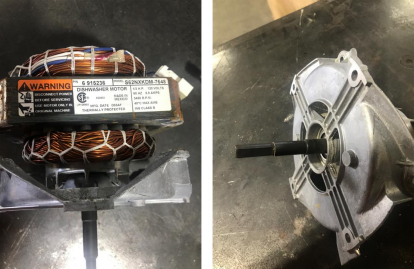
To demonstrate the tremendous advantages of laser cladding over traditional welding for journal build-up restoration, we used a wash machine motor armature. See Figure 1. This output journal has a starting diameter of 0.43” X 1” length [11 mm Ø x 25.4 mm]. This small diameter is nearly impossible to fix with traditional welding. The goal is to build up enough material to achieve a 0.5” diameter.
Figure 1 – Dishwasher Motor and associated journal shaft
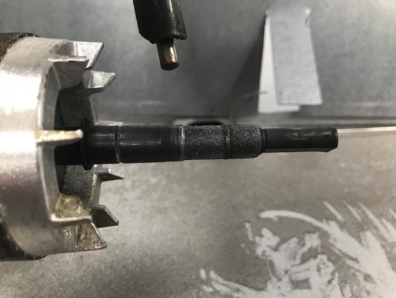
No one would even think of TIG or MIG welding up a shaft of this small of diameter, 11 mm [0.43”] and a length of 1”. See Figure 2.
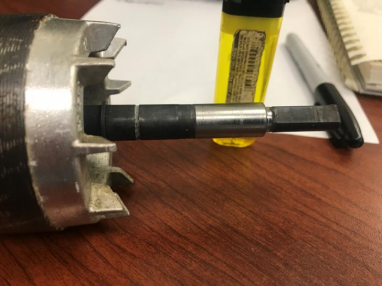
The demonstration of the low heat weld overlay is to build up 0.030” per side with 316 SS and machine to 0.5”. This is not achievable with any other welding process.
See Figures 2 and 3 – Before and after pictures.
Figure 2 – First layer approximately 0.015” per side
Figure 3 – Finished machined 0.5” Diameter
Conclusion
Laser Cladding is a very low heat weld overlay process that enables the remanufacturing of many components that, to date, were unrepairable or cost-prohibitive by any other welding process. In addition, the very smooth as-clad surface makes the post-clad machining very affordable. This opens the door to repairing a whole new portfolio of electrical armatures.
This low heat and associated small heat-affected zone creates a robust, fatigue-resistant repair, which can be applied to much larger armatures.
Titanova Capacity
Titanova has two stations for laser cladding refurbishment of armatures, shafts, and rolls.
#1 6000 lbs, 13’ 7” 72” swing
#2 20000 lb, 32’ and 100” swing.
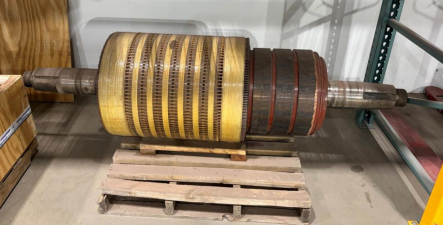
An example armature that only has 7” long defective journals. This armature is 4750lb and has an 88” OAL. See Figure 4.
Figure 4 – GE 824 DC armature
The only area to be repaired is one end. See Figure 5.
The customer pre-machined the journals by 0.025” below the finish.
Figure 5 – Surfaces to be repaired.
Figure 6 – Laser Clad journal
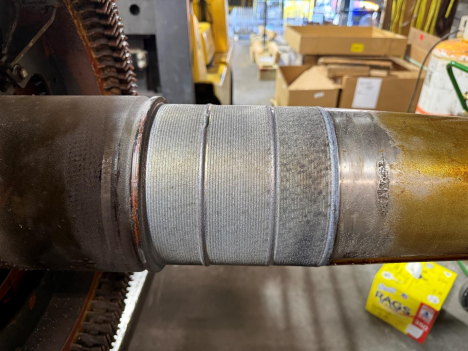
Titanova laser clad 410 SS to these journals, producing a pore free overlay with a hardness of approximately 35 HRC. We can also build out thrust faces, around key-ways, and tapered surfaces.
The time required to perform this laser weld overlay repair is approximately 1 hour, including setup. Therefore, less than 1-day turnaround times are achievable
Conclusion
Titanova laser cladding technology for repairing armature journals enables the weld repair of all armatures while at the same time realizing significant cost and time savings for the Electrical motor repair industry. Contact Titanova for a quote today!
Electric motor armatures are critical components in industrial and commercial systems, and journal wear is one of the most common failure points. Traditional repair methods like TIG/MIG welding (overlay welding), sleeving, or stubbing often introduce excessive heat, distortion, and machining complexity, especially on small-diameter shafts.
Laser cladding (also known as laser weld overlay / overlay welding) offers a fundamentally different approach: precision material deposition with minimal heat input, enabling reliable restoration of even the most delicate armature journals.
Titanova’s Advantage in Laser Cladding
Titanova, Inc utilizes laser cladding technology (laser cladding services) to create thin, controlled weld overlays that significantly reduce heat-affected zones (HAZ) and distortion. This makes it possible to remanufacture electric armature journals ranging from very small diameters to large industrial shafts—without relying on sleeving or stubbing techniques.
One of the key advantages is the ability to apply low-dilution surface modification, allowing engineers to restore or enhance surfaces with corrosion- or wear-resistant alloys. Depending on application requirements, Titanova can apply laser cladding services using:
Stainless steels for corrosion resistance
Nickel- and chromium-based alloys for high-temperature and chemical resistance
Cobalt-based alloys (such as Stellite™) for extreme wear environments
Why Precision Laser Cladding Matters
Compared to conventional welding methods (overlay welding), laser cladding introduces a controlled and highly efficient repair process:
Thin Clads
Minimal pre-machining required (typically ~0.025” per side)
Reduced material build-up lowers heat input and post-processing requirements
Low Heat Input
Extremely small heat-affected zones
Minimal distortion, preserving shaft geometry
Low dilution ensures material integrity and performance
High Deposition Efficiency
Deposition rates approximately 3–5× faster than TIG or MIG welding (overlay welding)
Faster turnaround for laser cladding services and refurbishment projects
Superior Surface Quality
Smoother as-clad surfaces reduce machining time and cost
Improved dimensional consistency compared to conventional weld overlays
Enhanced Material Performance
Enables tailored surface properties for corrosion and erosion resistance
Alloy selection optimized per application requirements
Demonstration: Super Low-Heat Journal Restoration
To highlight the capability of laser cladding in extremely small-scale applications, Titanova conducted a demonstration using a dishwasher motor armature.
Starting journal diameter: 0.43 in (11 mm)
Length: 1 in (25.4 mm)
Target finished diameter: 0.50 in
Material build-up: ~0.030 in per side using 316 stainless steel via laser cladding services
Such a small-diameter shaft is typically considered impractical or impossible to repair using TIG or MIG welding (overlay welding) due to excessive heat distortion and lack of control.
The process successfully:
Built the required material layer by layer
Maintained dimensional stability
Allowed precision machining to final specification
The result was a fully restored journal at 0.5” diameter with a smooth, machinable surface finish.
Industrial-Scale Application
Laser cladding is not limited to small components. Titanova has demonstrated large-scale refurbishment capability using laser cladding services on heavy industrial armatures, including:
6,000 lb capacity systems (13’7” length, 72” swing)
20,000 lb capacity systems (32’ length, 100” swing)
For example, a 4,750 lb GE DC armature (Model 824) with an 88” overall length was successfully repaired using localized laser cladding services on only the damaged journal areas.
Additional build-ups possible for thrust faces, keyways, and tapered surfaces
Speed and Turnaround Advantage
One of the major operational benefits of laser cladding services is speed. Typical laser cladding repairs require:
~1 hour of processing time (including setup for journal repair)
Potential same-day or next-day turnaround
This significantly reduces downtime compared to conventional overlay welding methods.
Key Takeaways and Impact
Laser cladding represents a major advancement in the repair and remanufacturing of electric motor armatures. By combining low heat input, precise material deposition, and high-quality surface finishes, it enables the restoration of components that were previously considered unrepairable or economically impractical.
For the electrical motor repair industry, laser cladding services translate into lower repair costs, faster turnaround times, improved component performance and lifespan, and expanded repair capability across a wider range of armature sizes.
Titanova, Inc continues to apply laser cladding and overlay welding technologies to industrial-scale refurbishment challenges, opening new possibilities for sustainable and cost-effective motor restoration.
Laser cladding is a cutting-edge process that involves applying a material onto a substrate to enhance its properties and extend its lifespan. This method incorporates exotic materials to achieve superior coatings that offer unmatched resistance to wear, corrosion, and high temperatures. Specialized coatings are crucial in industries demanding the highest performance and durability.
This article explores laser cladding for advanced coatings, highlighting the challenges and benefits of using exotic materials. We will also examine its application in high-performance environments and innovative uses across various industries.
Challenges and Benefits of Laser Cladding Exotic Materials
The laser cladding process presents both challenges and benefits when working with exotic materials. These include:
Material Compatibility and Surface Properties Enhancement
Exotic materials possess unique properties like high melting points, specific thermal conductivities, and varying thermal expansion coefficients. These characteristics can complicate the process of achieving a strong bond between the cladding material and the substrate. However, successfully cladding exotic materials can significantly enhance the surface properties of components, such as corrosion resistance and thermal stability.
Thermal Management and Minimal Heat-Affected Zone (HAZ)
Managing the heat input is crucial to avoid defects like cracking, porosity, or unwanted phase transformations. Exotic materials may require precise control of the laser parameters to prevent thermal damage. Nevertheless, the process creates a minimal HAZ due to its localized heating, which is beneficial when working with materials sensitive to thermal cycles.
Oxidation, Contamination, and Customization
Some highly reactive exotic materials can be easily contaminated when exposed to air at high temperatures, necessitating an inert gas environment. Despite this, the process can be easily customized for different materials and applications, enabling the development of tailored solutions for specific engineering challenges.
Microstructural Control and Enhanced Mechanical Properties
Exotic materials can make achieving the desired microstructure challenging due to their complex phase diagrams and the rapid cooling rates associated with laser cladding. On the positive side, the technique can be used to create coatings with superior mechanical properties by optimizing the microstructure of the clad layer.
Equipment Wear and Tear Versus Versatility
These unique materials can be abrasive or corrosive, increasing wear and tear on the laser cladding equipment. Conversely, laser cladding is compatible with various materials — including metals, ceramics, and composites — making it suitable for multiple industrial applications.
Precision and Complex Geometries
Precise control over the process parameters is required to avoid defects and achieve the desired outcomes. However, laser cladding offers high precision, allowing for material deposition with minimal waste and precise control over the thickness and location of the clad layer. Furthermore, it can be applied to complex geometries, which is advantageous for enhancing intricate parts made from exotic materials.
Applications and Innovative Uses in High-Performance Environments
These applications illustrate how laser cladding exotic materials can meet the extreme demands of high-performance environments in various industries:
Aerospace
Titanium alloys are utilized in the aerospace industry for advanced coatings on engine components. These coatings boost turbine blade efficiency by enhancing high-temperature performance and driving progress in aerospace technology.
Oil and Gas
Tungsten carbide and cobalt-chrome coatings are applied to drilling equipment to significantly enhance wear resistance and extend the lifespan of tools. This innovative approach addresses abrasive conditions in deep drilling environments and suggests new directions for developing more durable drilling technologies.
Mining
Hardfacing with tungsten carbide on mining equipment boosts resistance to severe wear and extends operational lifespan. It ensures that tools like excavator buckets and crusher liners perform effectively under harsh conditions, and there is potential for ongoing improvements in hardfacing materials.
Defense
Composite materials and ceramic coatings are employed to create advanced armor plating for military vehicles and protective gear. These technologies demonstrate the potential for innovative solutions, offering enhanced ballistic protection in defense equipment and protective gear.
Marine
Nickel-aluminum-bronze alloys and ceramic composites coat marine propellers, preventing cavitation and corrosion. This technology opens up opportunities for advancements in marine equipment durability by maintaining propeller performance in harsh marine environments.
Choose Titanova for Cutting-Edge Laser Cladding Solutions!
Titanova provides expert laser cladding exotic materials using a direct fiber-coupled laser system for components up to 45 feet long and 10 feet wide. Our advanced technology guarantees exceptionally pure, high-quality weld overlays and thorough in-house testing for top performance.
Contact us now to discover how we can meet your needs!